Naya Tune
The Tune is the dial module: a rotating knurled ring around a glass touch surface, with haptic
feedback on the dial and an RGB LED ring. This page covers its boards, chips, haptic dial, touch
surface, LEDs, battery and base, plus what a user or tool author meets: the dock address, the LED
count, the dial settings, the gesture vocabulary and what the host receives. The one thing to know: the
dial's resistance is a magnetic brake (per the vendor), and no angle sensor is visible on any exposed
board. One Tune was photographed, once: left-filing pages 17-26 are the same images as right-filing
pages 14-23 (CRL IP2 p17 = CRR IP2 p14), a pre-production sample received 2025-06-20.
At a glance
- MCU ST STM32F411CEU6; Qi receiver Maxic MT5705; charger SG Micro SGM41523; buck-boost SGM62117.
- 24 RGB LEDs on the touch disc; a Hynitron CST3xxx touch controller (CST3640 likely).
- Dial resistance from a XeelTech "Hapticore" magnetic brake; a separate LRA gives touch feedback.
- Filed battery 1000 mAh; the manual and website say 1500 mAh.
- Dock address
0x40left,0x41right.
Manual
Tune user manual v1.1.0 (PDF); every version is listed on Manuals.
What it is
The Tune is a dial module: a rotating knurled ring (the manual calls it the "Crown") around a glass touch surface (the "Gesturepad"), with haptic feedback on the dial and an RGB LED ring DOC2. The v1.1.0 manual prints a 1500 mAh battery, 69 x 69 x 28 mm, a crown of "CNC Machined Aluminum with Soft-Knurled Finish" and an RGB LED ring. The 2023 campaign spec sheet gave 66 mm across, 28.5 mm high, 120 g, 1500 mAh, a pressure-sensitive crown press, and crown inputs rotate left/right, press, long press, double press and press-and-rotate DOC28.
The dial's resistance comes from a XeelTech "Hapticore": per the vendor a magnetic brake (ferrofluid plus an electromagnet), not a motor, driven by the crown's outer gear at 2:1 (the Hapticore turns twice per crown turn). The crown is held on by magnets and pulls off to expose the bearing bracket and gear teeth. A separate LRA vibration motor gives feedback for touch and press. Marketing named it "Hapticore Driver by Xeeltech" with nine haptic modes and the feature "Naya Pulse"; no part number is known DOC9101415.
Main board (the ring)
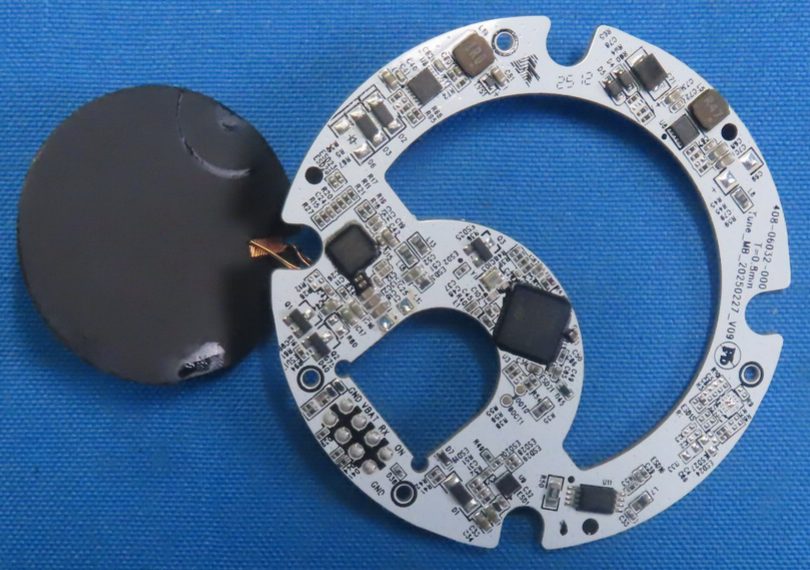
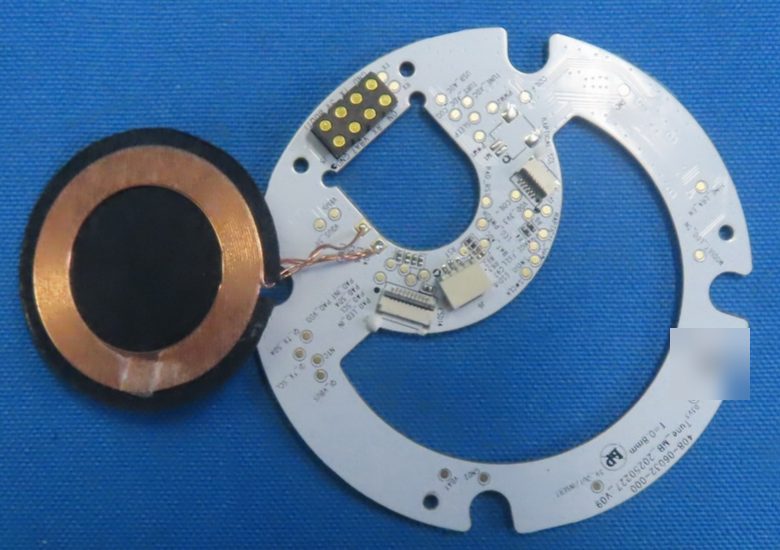
The main board is Tune_MB_20250227_V09, part number 408-06032-000, 0.8 mm, stamp 25 12, about
58-60 mm across with a C-shaped inner island DOC INFERRED CRL IP2 p18; CRL IP3 p19, p211.
| Part | Identity and marking | Evidence |
|---|---|---|
| MCU | ST STM32F411CEU6 (UFQFPN48, 7 x 7 mm; Cortex-M4F, 100 MHz, 512 KB flash, 128 KB RAM), marked STM32F / 411CEU6 / GQ2CU179R / CHN GQ 320. The modules moved from a Holtek MCU to the STM32F411 in May 2024 |
DOC CRL IP3 p19-p2011112 |
| Qi receiver | Maxic MT5705 (U15), a 5 W WPC receiver SoC with an I2C interface, lot 240801; pads QI_?X_SCL / QI_?X_SDA give the MCU an I2C link to it (so "charging only, no data" holds for the host, not for the MCU) |
DOC CRL IP3 p19-p20 |
| Charger | SG Micro SGM41523 (U8, marking SGM / 41523DF / S2A3C), a standalone switch-mode single-cell Li-ion charger with an NTC input (RT1/RT2 divider beside it) |
DOC CRL IP3 p20-p21 |
| Buck-boost | SG Micro SGM62117 (U6, marking 01KGH), next to a 0.47 uH inductor; its role (3.3 V from the cell, or 5 V toward the dock) is not established |
DOC INFERRED CRL IP3 p19-p20 |
| Other parts | 16 MHz crystal YC16.0 (Y1); 1AM NPN (Q3); two SL Schottky diodes (D2, D3) that OR the Qi and dock inputs (inferred); two T4 switching diodes; a 100 uF tantalum (J107); a 1.0 uH charger inductor (L14); one unpopulated IC footprint; many unmarked ESD parts |
DOC INFERRED CRL IP3 p19-p21 |
| Connectors | an FPC of about 10 contacts to the touch disc, two flip-lock ZIFs on the inner island, J1 (about 6-8 contacts) toward the haptic assembly, and a white 4-contact header J6 |
DOC INFERRED CRL IP2 p18; CRL IP3 p19 |
Dock block J5 |
8 contacts in a 1-2-2-2-1 stagger labeled GND, VBAT, RX, ON / GND, TX, a 5 V line, BOOT1; two paler pads beside it are either separate test pads or contacts 9-10 (readers disagree) |
DOC CRL IP3 p19 |
| Debug and boot pads | BOOT0, BOOT1 (beside the MCU), SWDIO, SWCL…, RST; BOOT1 also reaches the dock block |
DOC CRL IP3 p19-p20 |
| Other net pads | PAD_LED_IN, PAD_SCL, PAD_SDA, PAD_INT, PAD_VDD, PAD_RST (to the touch disc); QI_VBUS, NTC, VBUS (x2), USB_ADC, BAT_ADC, VDD_3V3, LED_PWRON, CHARGE_FULL |
DOC CRL IP3 p19 |
| Actuator drive pads | M1 (a 2-pad footprint), PWM1, PWM2, SLEEP, COIL+, COIL-, TUNE_ADC, TUNE_ADC_COIL, and an I2C pair HAPTICAL_SCL / HAPTICAL_SDA; an unmarked 8-lead driver U11 sits nearby (an H-bridge, inferred). Given the vendor's description, the M1 footprint may be the LRA's and the coil pads the brake's |
DOC INFERRED CRL IP3 p19 |
The haptic dial
The dial actuator is a black cylindrical can with visible copper windings in a recess under the Qi coil; it carries no marking. It fits the vendor's description of the Hapticore brake (an electromagnet acting on a magnetic fluid), which is not a part identification DOC INFERRED CRL IP2 p1819. No rotary encoder, Hall sensor or magnetic angle IC is visible on any exposed Tune board; the dial angle is most likely sensed inside the actuator assembly and the detents made in firmware (a programmable haptic knob) INFERRED. The dial ring is a silver knurled ring, unmarked (marketed as CNC-machined aluminum) DOC CRL IP2 p17.
Touch and LED disc
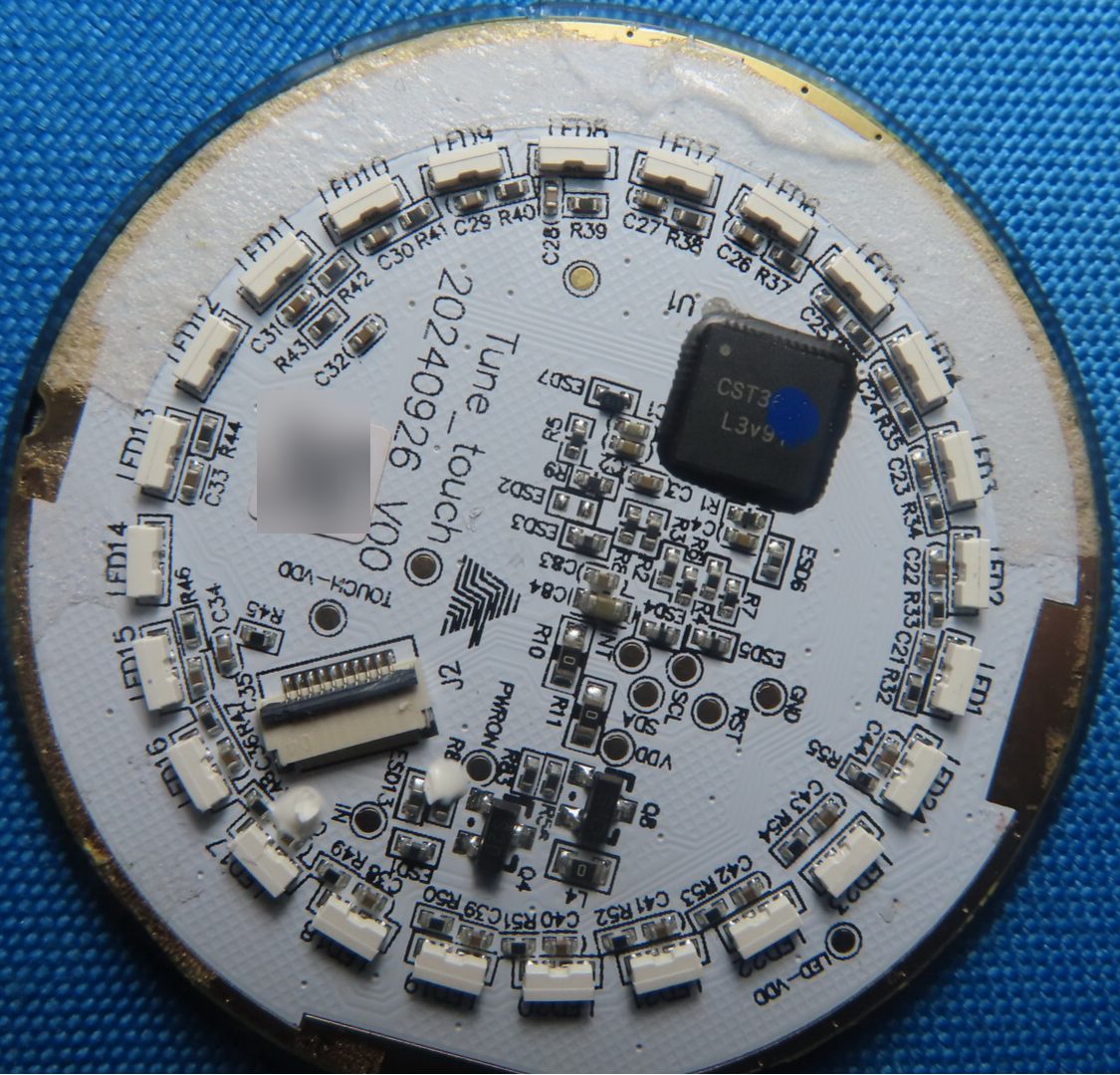
The disc is Tune_touch 20240926 V00, about 45 mm, bonded under a black glass disc of about 45 mm. It
carries the touch controller and a ring of 24 side-view RGB LEDs (LED1-LED24, one data line
PAD_LED_IN, no driver IC). The vendor raised the ring from 8 to 24 LEDs in 2023, with a diffuser
laminated under the glass DOC CRL IP3 p22; CRL IP4 p2319. The Touch and Track carry one LED each, so the
ring is the Tune's alone DOC1.
The disc's touch controller is marked CST3 plus a digit hidden under an ink dot; the Touch module's
controller is a Hynitron CST3640, so the same part is likely (a candidate only) DOC INFERRED CRL IP4 p23.
Its J2 is a 10-contact flip-lock FPC; host pads VDD, GND, SDA, SCL, RST, INT, IN, and
switched rails PWRON, TOUCH-VDD, LED-VDD DOC.
Unidentified small parts
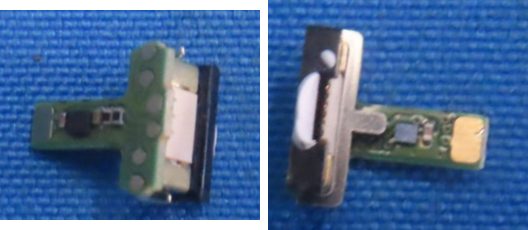
A small T-shaped green sub-board (about 10 x 7-9 mm) with a slot, a white "pill" and 6 pads is unidentified; a micro slide switch is the leading reading, and it is too small to be a USB-C port. A housed round part with a clip and a center screw beside the dock block is also unidentified DOC INFERRED CRL IP2 p18; CRL IP4 p24 (details).
Battery and power
The battery is an FH 202030 block pack, 3.7 V 1000 mAh 3.7 Wh, in blue PVC (about 20 x 20 x 30 mm by
its size code, inferred), dated 20250603, with three wires (red, white, black) to a white
3-position plug DOC CRL IP4 p25-p26; CRL IP2 p181.
The capacity figures disagree: the filed sample has 1000 mAh; the website and the 2023 campaign spec sheet said 1500 mAh; the v1.1.0 manual says 1500 mAh; a 2024 update says the Tune got a new assembly method that fits a larger battery. Retail capacity is not confirmed. Marketing also claimed a 14-day runtime DOC281315 (details). The Qi coil is a flat copper spiral on black ferrite, about 30-31 mm, unmarked DOC INFERRED. See Power and batteries.
Base
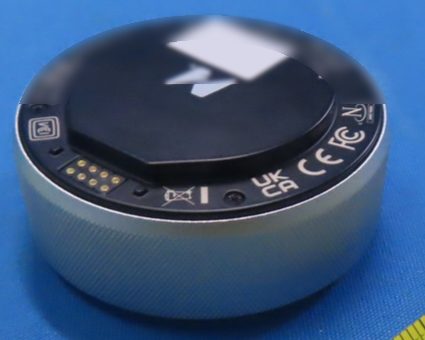
The base is a black molded cover about 64 mm across with 6 silver rectangular blocks in rim pockets
(magnets or steel plates, not determined) and 8 flat gold pads in a recessed 1-2-2-2-1 block; marks
include CE, the FCC logo, UKCA and WEEE; the label has a P/N whose digits are not legible and a
serial-number field (value not reproduced) DOC CRL IP2 p17-p181
(details).
As the host sees it
- Dock address.
0x40on the left,0x41on the right MEASURED (owner's board, 3.41.0, 2026-09-03; a second board, 3.28.7, 2026-09-19; also nayactl pull request 27). - LED indices. How many LED map indices a docked Tune follows is not settled and may depend on module firmware: a band test on 2026-09-08 saw 88-96 lit with a Tune in the left bay; on 2026-09-10 index 88 alone lit it; a Tune on module firmware 2.1.2 took color on 88-93 only while 94-111 stayed white. The board carries 24 LEDs MEASURED DOC (owner's board, 3.41.0, module 2.3.3; a second board, 3.28.7, module 2.1.2, 2026-09-19) (details).
- Dial settings. NayaFlow 1.25.1 offers "Ticks per rotation" 5-170 (default 72), "Tick strength" 0-100 (default 75) and ticks on/off (default on). On the device the detent spacing is stored as degrees per detent (360 divided by the value gives detents per turn) STATIC MEASURED4 (owner's board, 3.41.0, module 2.3.3, 2026-09-16). See Module fields.
- Gesture vocabulary. NayaCore 6.11.0 names for the Tune: dial
rotate,clockwise_rotate,counter_clockwise_rotate; touchvertical,horizontal,tap,double_tapand fourswipe_*directions at 1-4 fingers;pinch,spreadandpinch&spreadat 2 fingers STATIC4. NayaCore refuses double-tap bindings for the Tune ("unsupported double tap behaviour for Tune module type"), so the double-tap names are not usable STATIC4. - What the host receives. Each dial detent sends one key; two-finger swipes stream a run of events quantized on finger motion (11-20 per swipe in the first capture); one- and three-finger gestures fire once on lift, whatever the speed or distance MEASURED (owner's board, 3.41.0, module 2.3.3, 2026-09-05). Resting a finger on the glass while turning the dial does not change the detents and adds one swipe on lift; there is no hold-and-rotate gesture MEASURED (2026-09-05).
- Stock bindings. NayaFlow's default: dial = volume down/up; one-finger vertical and horizontal = scroll; two-finger tap = play/pause; three-finger tap = mute; two-finger swipes = brightness up/down and rewind/fast-forward; three-finger swipes = keyboard LED brightness and previous/next track STATIC4. The manual's defaults are Crown = volume, one finger = scroll, two fingers = brightness and tab, three fingers = play/pause, seek and track, and it warns that some units may ship without the latest configuration and should be updated with NayaFlow DOC2.
- Firmware notes. Module 2.3.2 made ticks exact instead of estimated and cut Tune LED power by about
20 % at full brightness; module 2.3.3 fixed phantom ticks near detents; keyboard 3.41.0 fixed phantom
ticks when switching layers DOC56. The v1.0.6 default keymap has a "Cycle Tune Mode"
key (
LB3on Layer 2) DOC3. - Firmware storage. Tune module firmware is an encrypted app (
Tune_UserApp.sfb) inside the module bundle; it lives in the STM32's internal flash (no external flash on the module) STATIC DOC4. See Module firmware.
Safety
The Tune's pack is a Li-ion block cell on flying leads; opening the module risks shorting it. Keep the module off conductive surfaces when undocked: its base pads are the dock contacts, which the manual says never to bridge DOC3.
Open questions
- OPEN Actuator part, driver
U11and theHAPTICALI2C device (details). - OPEN Exact touch-controller part (details).
- OPEN The T-shaped sub-board, the housed round part and
U9(details). - OPEN
J5: 8 or 10 contacts (details). - OPEN Base blocks magnet or steel (details); base part-number digits (details).
- OPEN LED indices a Tune follows on module 2.3.3 (details).
- OPEN Retail battery capacity (details).
Sources
-
FCC ID 2BQ4V0825CRL (the module photos are in both halves' filings): exhibits on the FCC record (FCC EAS search, grantee 2BQ4V; mirror fccid.io/2BQ4V0825CRL). Codes are explained on Regulatory records. ↩↩↩↩↩↩↩
-
Naya Tune User Manual Version 1.1.0 (vendor PDF
Naya_Tune_UserManual.pdf), p2, p6; see Manuals. ↩↩↩↩ -
Naya Create User Manual Version 1.0.6, FCC ID 2BQ4V0825CRR user manual exhibits (fccid.io). ↩↩
-
NayaFlow 1.25.1: settings table, installer default profile, and NayaCore 6.11.0 strings and embedded module bundle (static reading). ↩↩↩↩↩
-
Vendor release notes, NayaTech/NayaFlow-releases (1.17.2, 1.25.0). ↩
-
Vendor beta release notes, NayaTech/NayaFlow-beta-releases (1.16.0, 1.23.0). ↩
-
nayactl, pull request #2. ↩
-
Kickstarter campaign page with its Specs Sheet, naya-create/naya-create (2023). ↩↩
-
Kickstarter update 8, 2023-11-28. ↩↩↩
-
Kickstarter update 10, 2024-01-06. ↩
-
Kickstarter update 13, 2024-05-08. ↩
-
Kickstarter update 14, 2024-07-24. ↩
-
Kickstarter update 15, 2024-09-03. ↩
-
Reddit, vendor post 13jydnp (2023-05-17); archived text, not live-verified. ↩
-
The vendor's former product pages, archived by the Wayback Machine (naya.tech captures); cited only. ↩↩